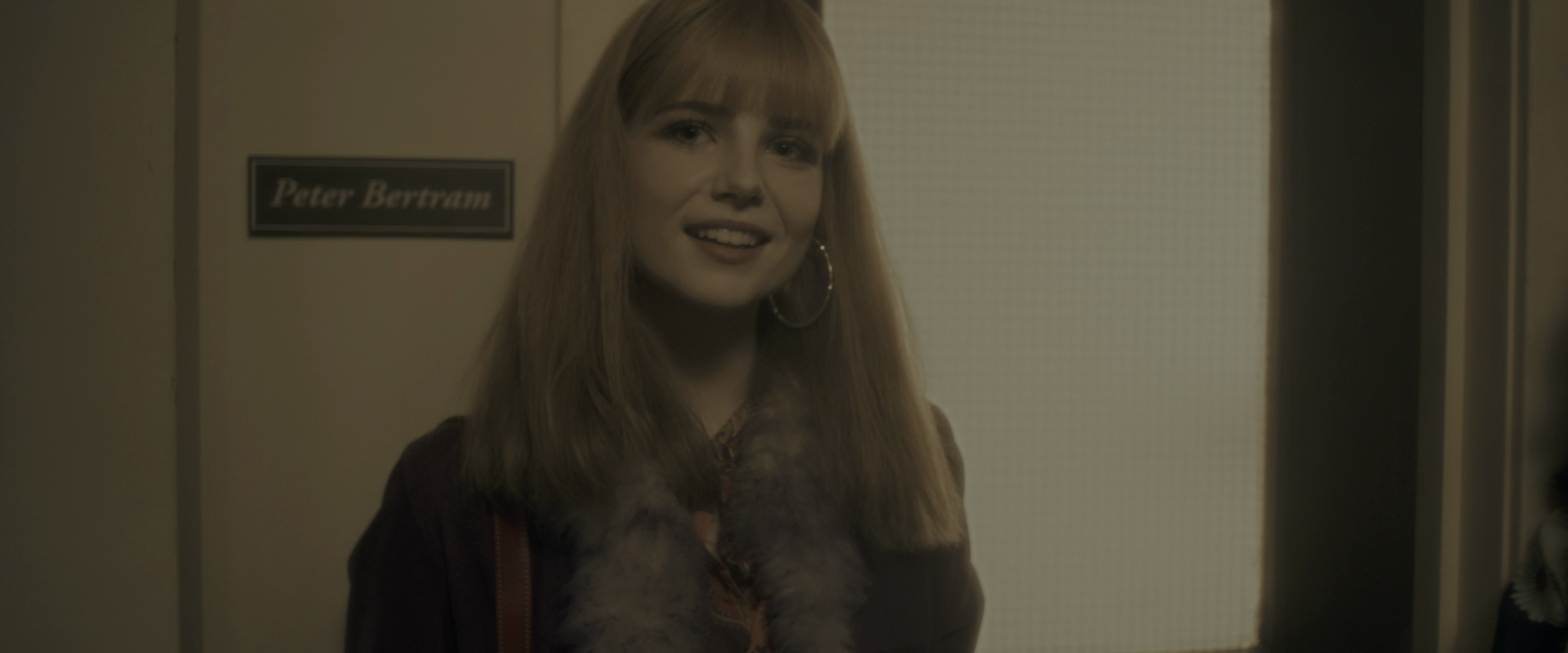
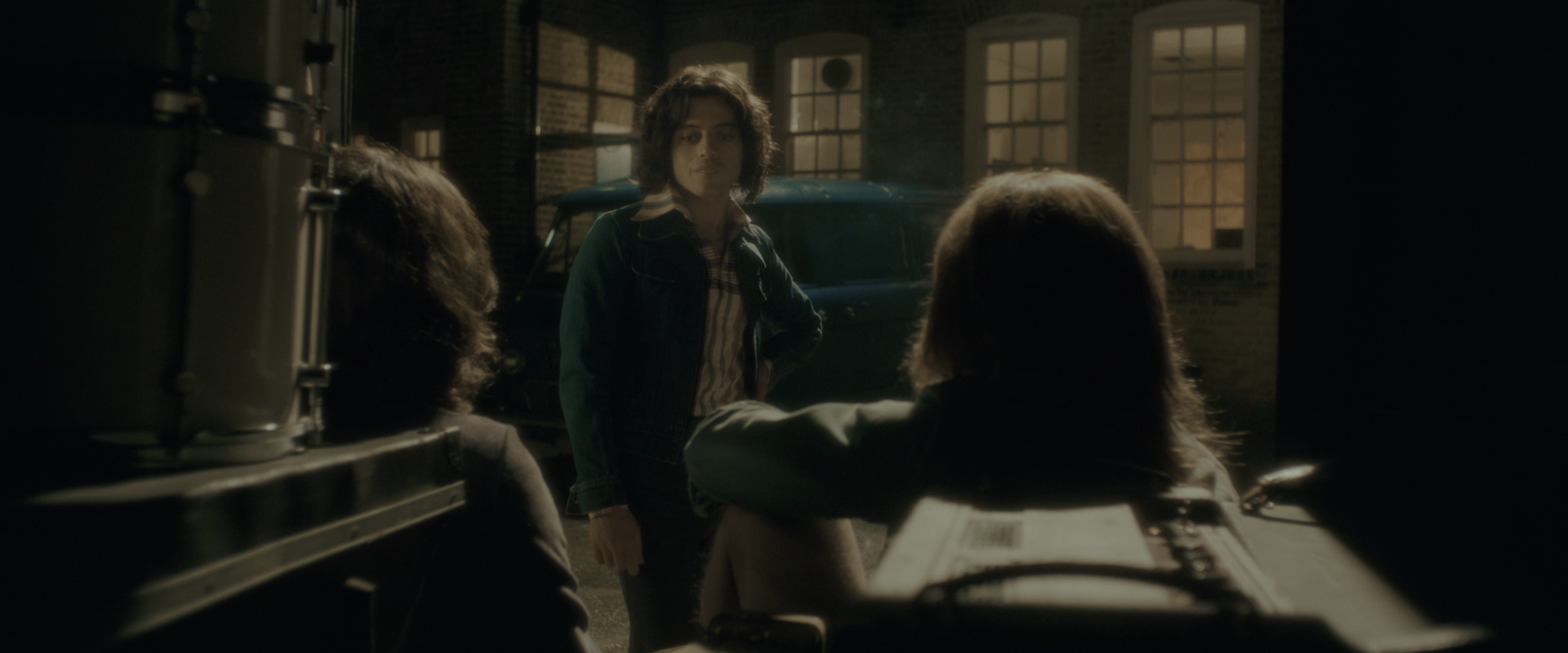
In the movie, a shy young Farrokh Bulsara (calling himself Freddie, but not yet Mercury) introduces himself to Brian May and Roger Taylor, guitarist and drummer of a band called Smile.
Smile's lead singer Tim Staffell has quit to join another group called Humpy Bong (fact check: true). Brian and Roger are suspicious of this newcomer with the big teeth until he sings a few bars of May and Staffell's song "Doin' Alright."
In real life, however, Freddie and Tim were good friends who went to the same art college. Freddie got to know Brian and Roger through Tim, and started running a flea market stall in Kensington with Roger in 1969.
Their friendship went through a year-long comedy of errors, in which Freddie became lead singer of a Liverpool-based band called Ibex, traipsing up and down England while he and the two other future members of Queen actually moved in together back in London.
Freddie quit Ibex. Tim quit Smile. And still these three lunkheads didn't figure out for weeks that history wanted them to be in a band together.
In the movie, Mercury meets the love of his life, Mary Austin, after a Smile concert. They fall for each other right away.
In reality, this happens in 1969, at the boutique where the then-19-year-old Austin works. If it even were love at first sight, it took Mercury a half year to ask her out. Brian May, who was dating her at the time, stepped aside.
The movie shows bass player John "Deaky" Deacon joining the lineup immediately; in fact, the band would go through three bass players in quick succession before finding him.
It also features an iconic moment where Freddie gets frustrated and rips off the top half of the mic stand for more on-stage mobility; this did in fact happen, but while he was singing with Ibex.
By the time Queen played its first gig at a half-empty Red Cross benefit in Cornwall in May 1970 (not in Smile's old London venue, as the movie has it), according to eyewitnesses, Freddie was well on his way to being the confident showman we know and love.
Another sign that Freddie was far more self-assured than the movie suggests: Their first on-stage song was "Stone Cold Crazy," a fast rock number he'd sung with Ibex already (and which would end up on the Sheer Heart Attack album).
The movie shows Queen opening with "Keep Yourself Alive," which would become their first single — but in May 1970, Brian May may not have even written the thing yet.
And when they did perform it, Freddie would stay way more true to Brian's lyrics than the movie suggests.
In one of the more cliched biopic moments of Bohemian Rhapsody, Queen sells its touring van in order to buy studio time to make its first album. In fact, they didn't need to. A guy named Norman Sheffield, owner of Trident, one of the best recording studios in the UK, offered Queen free studio time and a stipend — in exchange for owning the band's output.
That turned out to be a deal with the devil. Queen's second manager, John Reid, came along in 1975 (not immediately, as the movie suggests) and had to spend much of his time extricating the group from its Trident deal. Freddie was so frustrated with Sheffield he wrote not one but two songs denouncing him: "Flick of the Wrist" and "Death on Two Legs."
Why didn't that incredible real-life drama make it into the movie? Possibly because Sheffield sued Queen for defamation after he heard a tape of "Death on Two Legs" — recorded in his own studio. Queen settled out of court.
A smaller note on the studio session scene: Bohemian Rhapsody shows the band getting creative while recording the lyrics of "Seven Seas of Rhye." In fact, only a brief instrumental version made it onto that first self-titled album.
A small point, yes, but not the first or last time the movie plays fast and loose with Queen's musical chronology.
In the movie, Elton John's manager John Reid takes over, and immediately sends Queen on a headlining tour of America. In fact, the band had already toured America twice (once nominally opening for a band called Mott the Hoople) before they met Reid.
A more egregious error is that Queen is seen playing "Fat Bottomed Girls" on this 1974 tour. In fact, they wouldn't write that song until 1978, for the album Jazz.
That matters because Jazz was a distinctly different and more controversial era of Queen music, one where the group was fighting the rising tide of punk with transgressive naughtiness of its own. "Fat Bottomed Girls" was inextricable from the other song on its double-A side, "Bicycle Race."
To promote them, Queen issued posters of naked women on bikes — which were promptly banned in both the U.S. and the UK. Undeterred, the band had naked women cycle around the stage of Madison Square Garden. Again, this might have made for an interesting movie scene!
The less said about Mike Myers' obviously fake music label executive "Ray Foster," the better — except to wonder why on earth his bestselling group Queen would have to ask his permission to record an album titled Night at the Opera. EMI's actual chief Roy Featherstone was a big Queen fan.
And while Featherstone did fret about "Bohemian Rhapsody" being too long and weird for a hit single, so did many people — including Elton John and the band's own bassist, John Deacon.
Notably, their comments are not among the negative reviews that flash up on screen.
Next comes the movie's weirdest bit of chronology rearrangement. We fast-forward to 1980, possibly to get to the "Freddie has a mustache" phase of Queen as soon as possible, and somehow Brian May hasn't invented "We Will Rock You" yet.
In reality, the band had been rocking stadiums with it since 1977, having been inspired by Queen fans chanting a football (soccer, for Americans) song at the end of a show in 1976.
Big deal, you might think. But just try to imagine a Beatles movie in which Paul McCartney doesn't come up with the tune for "Sergeant Pepper's Lonely Heart's Club Band" until after Let It Be. It would make no sense! Fans would be burning multiplexes down! Yet that's exactly the amount of time-shifting of a defining hit that has happened here.
Given that Bohemian Rhapsody goes out of its way to please fans with deep cuts like "Doin' Alright" and "Lazing on a Sunday Afternoon," it's odd that it should go out of its way to displease them too.
Another small note: Freddie gets dinged in the movie for constantly being late to recording sessions. He sometimes was, but so were the others. Indeed, the acoustic guitar-led hit "Crazy Little Thing Called Love" began life in 1979 as a song the band could record "before Brian gets here."
Bohemian Rhapsody shows Jim "Miami" Beach taking over as Queen's manager after John Reid commits the unpardonable sin of suggesting that Freddie take a massive payout to abandon the band and record a solo album. Freddie is so incensed he kicks Reid out of his limo.
In fact, Reid was just too busy managing Elton John's stratospheric career to handle Queen too, and got a nice payout for ending his time with the band early. As for solo albums, I can't stress this enough: Everyone did them and they weren't a big deal.
Roger Taylor was the first, releasing Fun in Space in April 1981. Not only were the rest of the band supportive, they even allowed him to release it at the same time as Queen's Greatest Hits.
When Freddie finally released his solo effort in 1985, Mr. Bad Guy, it was the most successful of them all — and it didn't even get close to breaking the band up as the movie suggests. In fact, they were just finishing a tour together at the time of its release, promoting their most successful album in years, The Works.
That's really why Queen knocked it out of the park at Live Aid — they had just been on the road performing all those songs. It had nothing to with the "let's get the band back together" rehearsal cliche, or with Freddie's AIDS diagnosis (which in all likelihood didn't happen until 1987).
Sometimes there's just no substitute for experience.
Much has already been written about the problematic way Bohemian Rhapsody approaches Freddie's sexuality. Suffice to say the movie presents him as the lonely prisoner of his personal manager Paul Prenter, who leads Freddie into an ever deeper world of drugs and gay sex.
In fact, Freddie had way more agency. He was the one who led the partying, not Prenter. Even Elton John marveled at Freddie's prodigious energy levels when it came to coke, booze and sex with mostly men but also women. (His beloved Mary Austin was far from the only woman Freddie would sleep with; he also had a serious multi-year open relationship with Austrian actress Barbara Valentin.)
While his bandmates could also party, and even quiet reserved married Brian fell in love with a woman named Peaches after a literal orgy Queen threw in New Orleans, "Freddie was out there eclipsing the lot of them, hurling caution into the hurricane," writes Lesley-Ann Jones in Bohemian Rhapsody: The Definitive Biography of Freddie Mercury.
Indeed, Jones' book is a litany of fascinating orgies, and is just the thing to read for inspiration if you don't feel like you're partying hard enough.
Freddie also had way more close friends. An entire entourage of people not seen in the film clustered around Freddie at all times, led by his ever-loyal personal assistant and stylist Peter Freestone. (Like all those in Freddie's orbit, Freestone was given a drag name — in his case, Phoebe.) You can get a sense of the size of Freddie's friend list in the video for his ironic hit single "Living On My Own," filmed at his 39th birthday party.
Nor did Freddie have to track down his partner Jim Hutton via the phone book in the manner portrayed in the film. They met in 1983 at the Copacabana, a gay club near Freddie's Kensington home, and kept in touch until they started dating full time in 1985. Hutton was a hairdresser at the Savoy Hotel, not a waiter. Freddie's chat-up line was "How big's your dick?"
And no, Freddie never actually came out to his parents. (It is true, however, that Live Aid was Hutton's first concert.)
Yes, Prenter later betrayed Freddie by outing him in an interview with the British tabloid The Sun (not a TV interview, as in the film). And as Jones writes, there was one time when Prenter was arranging a line of men for Freddie to sleep with, while Freddie had lost interest — but that was because Queen's impeccably well-mannered frontman "was too polite to say anything."
Considering the involvement of the real Brian May and Roger Taylor in Bohemian Rhapsody, it's probably not surprising that the movie shies away from some of the band's true sour (and most dramatic) moments.
The one stain Queen will never get out is the fact that it performed at Sun City, the Las Vegas-style resort of white apartheid South Africa, for which the band was slapped with a substantial fine from the British Musician's Union.
But there are enough glorious, tension-filled true stories in the band's history for a trilogy of movies — such as the time they embarked on the first major tour of South America in rock history, were treated as gods, and may have helped hasten the downfall of the military junta in Argentina. Or the time they were the first western rock band to play behind the Iron Curtain in Hungary, again just a few years before the political situation changed for the better.
Or the fishbowl nature of Freddie's existence; the one time he tried to go to the bathroom without a member of his entourage, his cubicle was surrounded by a screaming mob.
Maybe now that Bohemian Rhapsody reigns supreme, we can expect more movies — or a TV series! — that can provide more of Queen's absolutely true greatest hits.
1. Freddie Mercuy wasn't diagnosed as hiv-positive until two years after Live Aid
No doubt, Freddie Mercury telling his fellow Queen members he is hiv-positive during the rehearsals for Live Aid (1985) is cinematic gold. In reality, Freddie hears the fatal news in 1987, and only later informs his fellow band members about it. He wants to keep his personal life and problems to himself and wants no pity, and especially would hate it if people would buy Queen albums for that reason. Not until 23 November 1991 does he issue a public statement saying he has Aids. One day later, he dies.
Foto: Twentieth Century Fox Film Corporation
2. Freddie met his partner Jim Hutton years earlier than the movie suggests
Jim Hutton is Freddie’s partner during the last six years of his life. While it is true that they met in 1985, Hutton did not serve food at one of the extravagant parties Mercury prided himself on. In reality, Hutton was a hairdresser, and they met as early as 1980 at a gay club. Hutton refused the drink offered to him by Mercury, having no clue he was the famous Queen frontman. A year and a half later they met again, at a nightclub. Mercury offers Hutton a drink again, and this time, he accepts.
3. Fat Bottomed Girls wasn't written yet when the band first toured the States in 1974
New manager John Reid arranges a series of concerts in the United States. In the movie, Queen fires up the stage while performing the classic song Fat Bottomed Girls. That song is from 1978 and thus had yet to flow from Brian’s pen when Queen toured the States for the first time in 1974.
4. Mercury did not have his iconic moustache when he came up with We Will Rock You
Brian May is impressed by the way the audience interacts with Queen (from the very beginning, that is Freddie’s explicit goal, because until that time audiences only screamed through the songs performed, as can be seen in footage of The Beatles). He has an idea for a song, he says in the movie. He stamps his feet two times and claps his hands on the third count. We Will Rock You is born. In the movie, Freddie already sports short hair and a moustache then, the way in which he only started expressing himself in the early 1980s. And thus not in ’77, when Rock You was released.
5. Freddie Mercury did not meet Brian May and Roger Taylor in 1970
In the movie, Mercury meets Brian May and Roger Taylor in 1970, on the night when singer Tim Staffel leaves their band Smile for Humpy Bong, a band he believes has a brighter future ahead of it. May and Taylor are impressed with Freddie’s voice and let him join the band. In reality, Staffel and Mercury had already been friends since the late 1960s, when they met at the Ealing College of Art. Moreover, Mercury and Taylor had been running a market stall together selling hip secondhand clothing in Kensington Market, long before Queen even existed. Incidentally, one of their customers was David Bowie, whom admirer Mercury gave a pair of glitter boots for free.
Foto: Twentieth Century Fox Film Corporation
7. Box in a box in a box in a box
It is true that Mercury asks Austin to marry him by giving her a ring. In the movie, that ring is in a blue box. Small detail, in reality that box was hidden in a larger box, which was in an even larger box, which was yet again in a larger box, etc… She said ‘Yes, I do’, but it never came to a wedding.
8. Freddie Mercury was not at odds with manager John Reid
In the movie, Freddie Mercury throws manager John Reid out of a car in the early 1980s when Reid suggests Mercury should go solo. In reality, Queen and Reid had already parted ways in a friendly manner in ’77, when Reid had been their manager for three years and his contract had run its full term. It was in fact the manager before Reid, Norman Sheffield, who had been a thorn in the band members’ sides. In spite of their successes (such as the number two hit Killer Queen, released in 1974), they had to live on 20 pounds per week. In the meantime, their manager drove a Rolls Royce, which in 1975 seduced Mercury to write the song Death on Two Legs (‘You suck my blood like a leech … You’ve taken all my money and still want more’).
9. The movie version of Seven Seas of Rhye is actually from Queen II
In 1973, Queen enters the studio to record its first album. The band doesn’t have any money, but it may use the Trident Studios during nightly hours. It is there that they record Seven Seas of Rhye, according to the movie. In reality, only a short instrumental version of the song ends up on the ’73 album. Queen II, which was released in 1974, contains the movie version of Seven Seas of Rhye, the band’s first hit single.
10. Queen was a well-oiled machine before their Live Aid performance
In the movie, Queen is on its last legs in 1985, after Mercury has gone solo (Mr. Bad Guy). They have to practice like maniacs not to look like fools during Live Aid. This is very far from the truth. In 1984 the album The Works is released, with giant hits like Radio Gaga and I Want to Break Free. To promote the album, Queen tours around the world for nine months, until May 1985. During that period, the band gives 50 performances, the high point of which is at Rock in Rio where 325.000 fans attend the concert. Queen is a well-oiled machine and the absolute highlight at Wembley on 13 July 1985.
Queen at Live Aid: the original footage.
11. The band did not actually split up in 1985
Freddie’s solo escapades leading to the band splitting up, like the movie suggests, is not correct either. After Hot Space, in 1982, all Queen-members do their own thing for a while. Both Taylor and May record solo albums (the latter with Eddie van Halen). Mercury too, that’s true. Mr. Bad Guy is released in 1985, two months before Live Aid. During this period, Queen records The Works as well, so the band splitting up could not be further from the truth. During a concert at Wembley, Mercury addresses the rumours about the band splitting up. “They are talking from here”, he says while turning around and sticking his butt out.
Watch the original footage of Mercury saying “They are talking from here” below.
12. The band does not fully share credits until The Miracle
In the movie, during the rehearsals for Live Aid the members of Queen tackle a problem they have been dealing with for some time. They decide that, from now on, they will share the credits for all new songs. Until then, the question of credits had been a bone of contention for the band. Take the B-side to Bohemian Rhapsody. Roger Taylor wrote that song, I’m in Love with My Car, and therefore received just as much royalties as Mercury, who wrote the A-side. The other Queen members May and John Deacon got nothing. The discussion happened, but the chronology is off here as well. Not until the album The Miracle, released in 1989, do the Queen-members share the credits. On A Kind of Magic, released in 1986, they only share the credits for the song One Vision, which was partly inspired by Live Aid.
The Sun of 4 May 1987 in which Paul Prenter tells all. Photo: popsike.com
13. Mercury's assistent got fired for a completely different reason
A good story requires a protagonist, but also an antagonist. In Bohemian Rhapsody, the antagonist is Paul Prenter, at first the aid of manager John Reid, later Freddie’s personal assistant. In the movie he fails to mention that Queen has been asked to perform at Live Aid, reason for Mercury to fire him. Prenter indeed got fired, but not in 1985, and not for that reason. He threw a party at Mercury’s house in Kensington and left the house in such a mess that he had to go. Him giving a sensational interview to The Sun shortly thereafter, revealing many details about Mercury’s private life, is correct. Even though that happened in 1987.
14. Light-eyed Mercury
The movie deserves a great deal of credit for going out of its way not to misrepresent reality. Truly spectacular is the way the Live Aid stage was reconstructed. The Queen members’ extravagant outfits have been recreated down to the smallest detail as well, and even include Roger Taylor’s socks. It is therefore striking that leading actor Rami Malek, who is praised globally for his portrayal of Freddie, doesn’t wear dark contact lenses. His teeth, hairdo and moustache were changed to resemble those of Mercury, but he kept his own light-colored eyes.
15. Jimmy Page or Brian May?
One of the trailers, not the actual movie, shows Brian May playing his guitar with a violin bow. May was horrified when he saw it. “That is a Jimmy Page thing (guitarist with Led Zeppelin),” he recently said. “I never did that.”
Watch the fragment in question below.
16. Ray Foster is fictional
Mike Myers plays EMI boss Ray Foster in the movie. He never existed. In the movie Foster refuses to release Bohemian Rhapsody, which lasts almost six minutes, as a single. It is no coincidence that Myers plays this role. In 1992, he plays one of the main characters in Wayne’s World. In the opening scene, Wayne and his friends are sitting in a car when Bohemian Rhapsody comes on the radio. What follows is an iconic headbang scene, which results in the Queen song ending up in the American music charts once again. The director had a Guns N’ Roses song in mind for the scene, but Meyers refused to participate without the Beëlzububs, Galileos, Figaros and Magnificos.
17. Songs are heard in years when they are not released yet
Finally, some songs are used at curious moments in the movie. At home on his piano, Mercury plays Lazing on a Sunday Afternoon when Queen’s first album has yet to be released. The song is on Queen’s fourth album, A Night at the Opera. Another One Bites the Dust (1980), the best selling Queen song of all time can also be heard at a strange moment, when it is actually the time of Hot Space (1982) in the movie.
But hey, what does it matter? It’s not a documentary that’s supposed to be historically accurate, it’s a movie. And a very succesful one at that, just like so many Queen albums. Critics often didn’t like them, but they sold like hot cakes. In fact, Greatest Hits I is the best selling album of all time in England, where 1 out of every 3 households owns it.
As the movie tells it, a young Freddie Balsura—then still using his family surname and working as a baggage handler at London's Heathrow Airport—happened upon a performance of May and Taylor's earlier band Smile on the very night their lead singer quit, talking his way into the group afterwards in the parking lot. In real life, however, Mercury had been friends with band since early 1969, having met lead singer Tim Staffell at Ealing Art College. By early 1970, when Staffell quit, Mercury had been living with May and Taylor and selling odds and ends at a clothes stall in the Kensington Market with Taylor and had made his ambition to be the band's singer very clear to his pals. He'd also been in and out of a couple of bands of his own prior to the genesis of Queen in April of '70.
In Bohemian Rhapsody, Freddie meets Mary Austin, his longtime girlfriend, the same night he met the band, telling her he liked her jacket before finding her at her work, fashion boutique Biba, days later to ask her out. The truth, however, is as complicated as his actual history with May and Taylor. May and Mercury used to frequent the shop to get a look at the "gorgeous" employees, as May explained in the 2000 documentary Freddie Mercury: The Untold Story. And it was May who first dated Austin, not Mercury.
"Strangely enough, Mary was the girl that I picked out as somebody fabulous, and I was kind of going out with her," told Yahoo! Entertainment in 2017. "And Freddie came up to me one day and said, 'Are you serious with Mary? Can I ask her out?' And he did, and they were lovers for a long time."
In the film, a drunk Freddie makes a very sloppy pass at a server at one of his debauched parties as the evening's turning into early morning and everyone's gone him. He's rejected, but they wind up talking until the sun comes up and years later, the singer looks him up in the phone book and they begin dating. In reality, Hutton was working as a hairdresser in the Savoy Hotel when he met Mercury in the gay nightclub Heaven in March of 1985. They remained together until Mercury's passing of AIDS-related bronchopneumonia in 1991.
In the film, Mike Myers gets a cheeky cameo as EMI record executive Ray Foster, who tells the band that he won't release "Bohemian Rhapsody" as a single, arguing that kids will never want to bang their heads to it in their cars. (Get it? Because Myers' Wayne's World revitalized the track's popularity thanks to a moment where his character does just that.) In reality, Foster didn't exist. He's roughly based on EMI chief Roy Featherstone, who was a huge fan of the band. However, he did believe the song was too long to be a single.
n the film, Freddie reveals to the band that he's signed a solo deal behind their back and wants to take a long break, enraging May, Taylor, and bassist John Deacon in the process. In reality, however, there was no estrangement to be heard of while Mercury was recording his 1985 solo debut Mr. Bad Guy, as Queen made 1984 release The Works around the same time before embarking on a 48-show tour from late '84 to mid-'85. At the time, they defied international boycotts by agreeing to play in South Africa during the country's apartheid era, doing more damage to their reputation than any of Mercury's antics ever really did.
Oh, and as for the notion that Freddie was the first and only member to record solo? Taylor beat him to the punch with 1981's Fun in Space, his first solo album—something creative consultants May and Taylor conveniently left out of the film.
In the film, Freddie reveals to the band that he is HIV-positive during rehearsals for the climactic Live Aid London performance in the summer of 1985. However, while the exact time Mercury contracted the disease remains a mystery, an HIV test taken in 1987 delivered the damning results that were only confirmed when his doctors contacted Austin to deliver the urgent news, as the singer was dodging their calls. And by Taylor's own account, the band wasn't made aware until early 1989.
In the film, by the time Freddie and the guys make it to Wembley Stadium for their career-revitalizing 25-minutes performance in the summer of 1985, it had been after years of not speaking or playing together. Of course, this is far from accurate. The last show of their tour to support The Works was just eight weeks before Live Aid. So, while it's certainly more dramatic to have to watch the boys make peace and get back into playing shape just as Freddie's coming to terms with his life-altering diagnosis, none of it happened that way.
Thanks to:
Dagblad van het Noorden
Mashable
History vs Hollywood